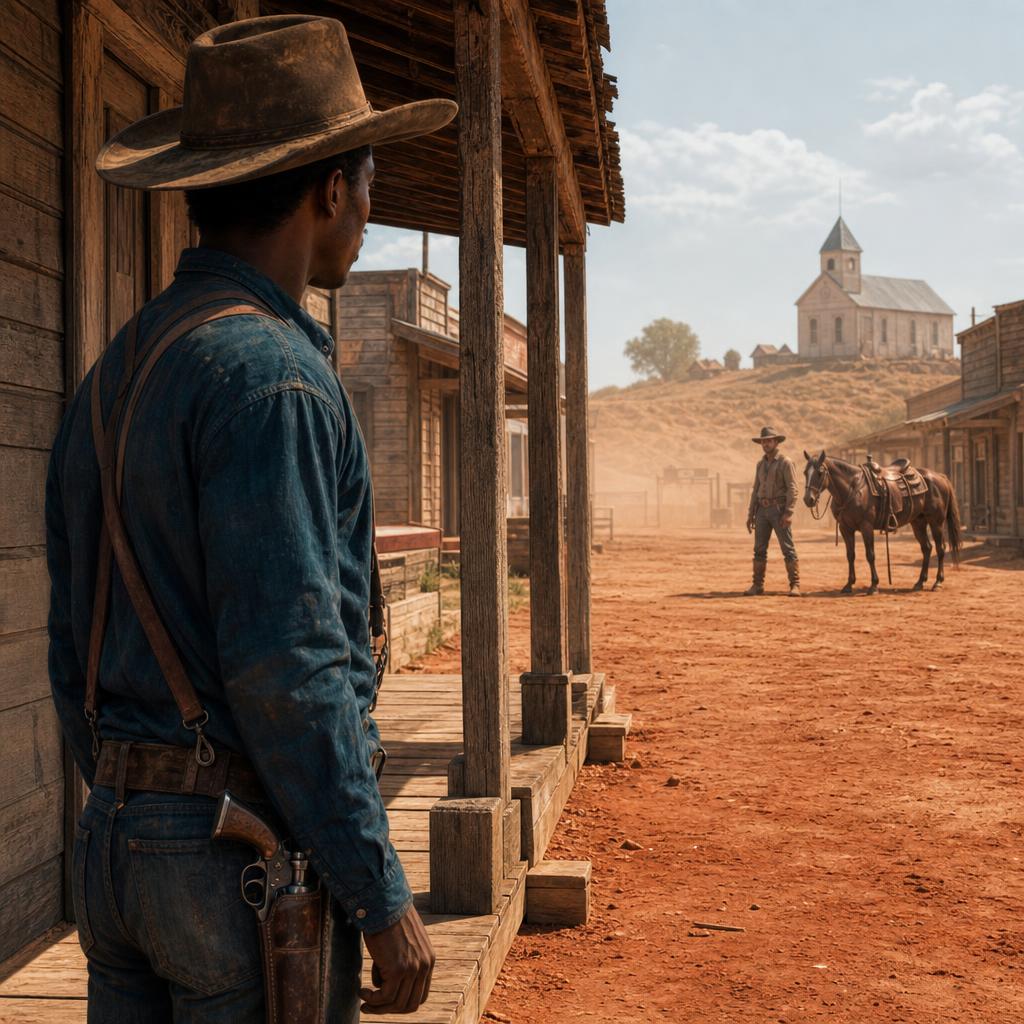
In the red-earth frontier town of Blacktail, a young gunman and a hostile stranger let pride turn a quiet afternoon into tragedy.
Chapter 1: The Red Earth of Blacktail
Now, if you was to ride your horse up through the tall grass of the Territory back in '84, you’d eventually hit a strip of red dirt road that cut through the valley like a long, bleeding scar. That road led right into the heart of Blacktail.
Blacktail wasn't the kind of place a man stumbled onto by mistake. It wasn't on no official government map, and the marshals over in Fort Smith didn't come around unless they was forced to. The town was built by folks who had laid their burdens down after the war—Black men and women who cleared the timber, laid the cedar planks, drove the iron nails, and built a sanctuary out of nothing but sweat, prayer, and grit. They had their own blacksmith, their own dry goods counter, their own livery stable, and an old church house sitting on the hill whose bell rang loud enough to wake the dead every Sunday morning.
Folks in Blacktail minded their own business, raised their cattle, and kept their eyes on the horizon. It was a peaceful place, mostly. But peace ain't something that just sits still; it’s something you gotta guard. And every town, no matter how quiet, got at least one weed growing up in the garden.
In Blacktail, that weed was young Caleb.
Caleb wasn't but nineteen years old, but he carried himself like he was fifty years of bad news condensed into six feet of bone and sinew. He had skin the color of dark walnut, eyes that didn't never blink when he looked at you, and a tongue lined with razor blades. His daddy had died down in Texas when Caleb was just a knee-high child, and his mama worked her fingers to the bone trying to raise him right, but Caleb had a spirit that just wouldn't take no polish.
By the time he turned seventeen, he was running with a wild crowd down near the river bottom, learning how to drink corn liquor and pull a iron fast. By nineteen, he had a heavy Colt .44 slung low on his hip, resting loose in a worn leather holster he’d oiled until it was slick as grease.
Caleb walked down the wooden boardwalks of Blacktail like he owned every plank. He’d stare down the old elders sitting out in front of the barber shop, spit his tobacco right on the toe of a man’s boot just to see if he’d say something, and swagger into the saloon itching for anybody to give him a sideways glance.
"That boy gonna find his grave before he finds his sense," old Reverend Harris used to say, leaning on his hickory walking stick as he watched Caleb strut past the church. "When a man carries fire in his pocket everywhere he walk, he bound to burn his own house down eventually."
And Caleb didn't care none. He thought he was made of iron. He thought he was the meanest thing breathing under the prairie sun.
Chapter 2: A Dust Cloud on the Horizon
It was mid-August when the heat came down so heavy it felt like a wet wool blanket pressed against your face. The prairie grass was dry as tinder, crackling underfoot like snapped twigs, and even the dogs stayed under the porch shade, too hot to bark.
Around two o'clock in the afternoon, the bell over the blacksmith shop gave a soft, accidental chime as the wind picked up. Over on the eastern ridge, a thin plume of white dust started rising up against the blue sky.
Old Man Josiah, sitting out on the porch of the dry goods store with his pocketknife and a piece of cedar pine, stopped his whittling. He squinted his good eye against the glare.
"Rider comin'," Josiah grunted to nobody in particular.
A single horseman emerged from the dust cloud, trotting slow and deliberate down the center lane. The stranger was riding a leggy bay stallion, its coat streaked with dried sweat and salt. But it wasn't the horse that caught everybody’s eye—it was the man sitting in the saddle.
He was pale—so pale the sun had burned his neck raw and red like fresh beef. He wore a dusty gray slouch hat pulled down low over a sharp, hawk-like nose, and his eyes were a pale, washed-out blue that looked right through a person without seeing 'em. A heavy leather gun belt was buckled tight around his waist, holding a pair of nickel-plated revolvers with pearl handles.
Miller was his name. Nobody in Blacktail knew where he come from, and truth be told, nobody cared to ask. He was the first white man to set foot down main street in near two years, and he rode in carrying an air that smelled like trouble from a mile off.
He stopped his horse right outside the watering trough in front of the saloon, swung his leg over the saddle, and let his boots hit the dirt with a heavy, hollow thud. He didn't offer no polite tip of his hat. He didn't say "good day" to the women walking by with their grocery baskets. He just stood there, wiping his mouth with the back of a dirty glove, looking around at the wooden buildings and the Black faces staring back at him from the porches.
Miller was a man who’d spent his whole life believing that the world belonged to him just by virtue of his skin, no matter how low or mean he lived his life. He’d come out into the Territory running from a hanging judge in Kansas, and he brought all his spite and vinegar along for the ride. Looking around Blacktail, seeing folks living free, building their own homes, and minding their own affairs, made something ugly curdle inside his chest.
He hitched his bay to the rail, spat a dark streak of tobacco juice into the watering trough—ruining the fresh water the horses drank from—and stomped his way onto the wooden boardwalk.
Chapter 3: The Spark and the Powder
Caleb was sitting inside the saloon, leaning back in a ladder-back chair with his boots propped up on a card table. He had a glass of cheap whiskey in his hand and a bad attitude brewing in his head.
When the bat-wing doors pushed open and Miller stepped inside, the room went quiet real fast. The piano player stopped his fingers right over the ivory keys, letting a sour chord hang in the thick air. The bartender, a big man named Big John who had scars on his forearms from his days as a blacksmith, picked up a rag and started wiping down the counter, his eyes locked square on the newcomer.
Miller didn't take off his hat. He walked right up to the bar, tossed a silver dollar onto the dark wood, and barked, "Whiskey. And don't give me none of that watered-down slop you keep for yourselves."
Big John didn't move a muscle for three long seconds. He just stood there, towering over the counter, his jaw set like granite. "We only serve one kind of whiskey here, mister," Big John said, his voice deep as a thunderclap over the hills. "And it’s five cents a glass."
From the back corner, Caleb’s chair legs hit the floorboards with a sharp clack.
Caleb stood up slow, hitching his trousers and sliding his right hand down until his fingers were resting light against the walnut grip of his Colt. He walked toward the bar with that slow, panther-like swagger he’d spent years practicing in front of the mirror.
"You talking awful loud for a man who lost his way," Caleb said, stopping about six feet behind Miller. "This here is Blacktail. We don't take to folks bringing that kind of lip into our house."
Miller turned around real slow, his pale eyes narrowing as he looked Caleb up and down. He saw a kid—a nineteen-year-old boy trying to play at being a giant. A nasty, mocking smile spread across Miller’s thin lips.
"Well now," Miller drawled, his voice rasping like sandpaper on pine. "Look what come crawling out from under the porch. I didn't ask for no talk from you, boy. Why don't you trot on back to your mama before you get yourself hurt?"
The word boy hung in the air like a cloud of poison gas.
Caleb’s face went dark as a thundercloud. His nostrils flared, and his knuckles went white where his hand hovered over his holster. Nobody called Caleb "boy"—not in Blacktail, not anywhere.
"You step outside," Caleb spat, his voice trembling with a dark, foolish rage. "You step outside right now and say that again to my face."
Miller chuckled, a dry, humorless sound, and took a small sip from the bottle he’d grabbed off the counter. "I’ll step out when I'm good and ready. But if I walk out that door, kid, you ain't gonna like how the afternoon ends."
"Out in the street," Caleb repeated, his chest heaving. "Five minutes. Or I’ll shoot you where you stand."
Caleb turned on his heel and walked out through the bat-wing doors, slamming 'em wide open so they swung back and forth, creaking in the hot prairie wind.
Chapter 4: The Forty-Pace Walk
Word spread through Blacktail like a brushfire in October.
"Caleb’s calling out a stranger!"
"It’s that white man who rode in from the north!"
Storekeepers turned the signs on their doors to Closed and shot the heavy iron bolts into place. Mothers grabbed their children by the arms, dragging 'em off the wooden boardwalks and pulling 'em inside behind thick oak shutters. Old Reverend Harris ran out of the church house, his black coat tails flapping in the wind, trying to reach the main street before the devil got his payment, but Big John caught the preacher by the arm at the corner of the livery.
"Don't go out there, Reverend," Big John said softly, his voice heavy with sorrow. "Ain't no prayer gonna stop what’s coming. They both got the sickness in 'em."
The main street of Blacktail emptied out until it looked like a ghost town. The only thing moving was a tumbleweed rolling slow across the red dirt and the dry wind whipping up little dust devils in front of the barber shop.
Caleb stood out in the middle of the street, right in the full glare of the afternoon sun. Sweat was pouring down his temples, stinging his eyes, but he didn't wipe it away. He kept his feet planted wide, his knees slightly bent, his eyes locked on the double doors of the saloon. He was filled up to the brim with pride—that terrible, blind pride that makes a man think he’s immortal right up until the cold lead hits his bone.
The saloon doors pushed open.
Miller stepped down off the porch, his boots kicking up two little puffs of red dust as he hit the street. He carried himself easy, like a man going out to check his mail, but his pale eyes were stone cold. He walked out about forty feet, stopped, and turned sideways, presenting a slim target like an old hand at the dueling game.
"You still got time to turn around and run, kid," Miller called out, his voice carrying clear over the wind. "I won't even shoot you in the back."
"Shut your mouth!" Caleb screamed back, his voice cracking just a little bit with the adrenaline surging through his blood. "You ain't leaving this town alive!"
"Suit yourself," Miller whispered.
The whole world seemed to shrink down to that forty-foot stretch of red dirt. The sun beat down mercilessly, heating the metal of their guns until they were hot to the touch. Somewhere off in the distance, a crow let out a single, harsh caw.
Then came the silence—that dead, heavy silence where seconds stretch out until they feel like hours.
Chapter 5: They Didn't Live to Tell It
Nobody could say for sure who reached first.
Some folks watching through the cracks in the window shutters said Caleb’s shoulder twitched first. Others said Miller’s hand was already moving before the word was out of Caleb’s mouth. It didn't really matter none. When two men go hunting for death, death don't make 'em wait long.
CRACK-CRACK!
The two gunshots went off so close together they sounded like a single, massive explosion echoing off the wooden storefronts. The smell of burnt black powder swept through the street, thick and sulfurous, clouding the space between 'em in a haze of blue-gray smoke.
For a second—just one terrifying second—neither man fell.
They stood there in the dust, staring at each other through the drifting gunsmoke like two statues carved out of wood.
Then Caleb took one shaky step forward. He looked down at his own chest with a look of pure confusion on his young face. Right over his heart, a dark, wet circle was spreading wide and fast across his denim shirt, turning the blue fabric black. His knees wobbled, buckling beneath him like wet straw. His Colt slipped out of his fingers, thudding softly into the dirt, and young Caleb pitched forward, hitting the ground hard with his face turned toward the church hill. He let out one long, rattling sigh... and then he lay still.
Five feet away, Miller let out a cruel laugh—a high, ragged sound—and raised his nickel-plated pistol as if to brag to the empty street.
But as he raised his arm, his body stiffened up tight.
Caleb hadn't missed neither. The young boy’s lead had caught Miller right in the side, tearing through his ribs and ripping deep into his vitals. Miller dropped his revolver. A thick stream of crimson bubbled up out of his mouth, spilling down his chin and staining his dusty shirt.
His pale eyes rolled back into his head, his legs gave out completely, and he collapsed sideways into the watering trough, knocking it over and spilling red mud and blood all over the wooden boardwalk. He kicked his boots twice against the planks, let out a wet gasp, and went lifeless right beside his horse.
The gunsmoke cleared slow, pulled away by the prairie breeze.
The main street of Blacktail was completely quiet again. The sun kept right on burning down from the sky, indifferent to the two bodies lying in the dirt forty feet apart.
Old Reverend Harris walked slow out into the street, his head bowed, his hands clasped tight behind his back. He stood between the two dead men—the meanest kid in town and the hateful stranger who’d ridden in from nowhere—and looked down at 'em. They looked small now. Just two cold piles of clothes and clay resting side by side in the dirt, all their pride and anger washed out into the soil.
"Lord have mercy on their foolish souls," the Reverend whispered to the wind.
Folks slowly opened their doors and stepped out onto the porches, looking at the waste of it all. Nobody cheered. Nobody celebrated. There wasn't no victory in it, no glory, and no lesson learned that hadn't already been paid for a thousand times before.
Just two men who let their pride drive 'em into the earth before their time. And they didn't live to tell it.