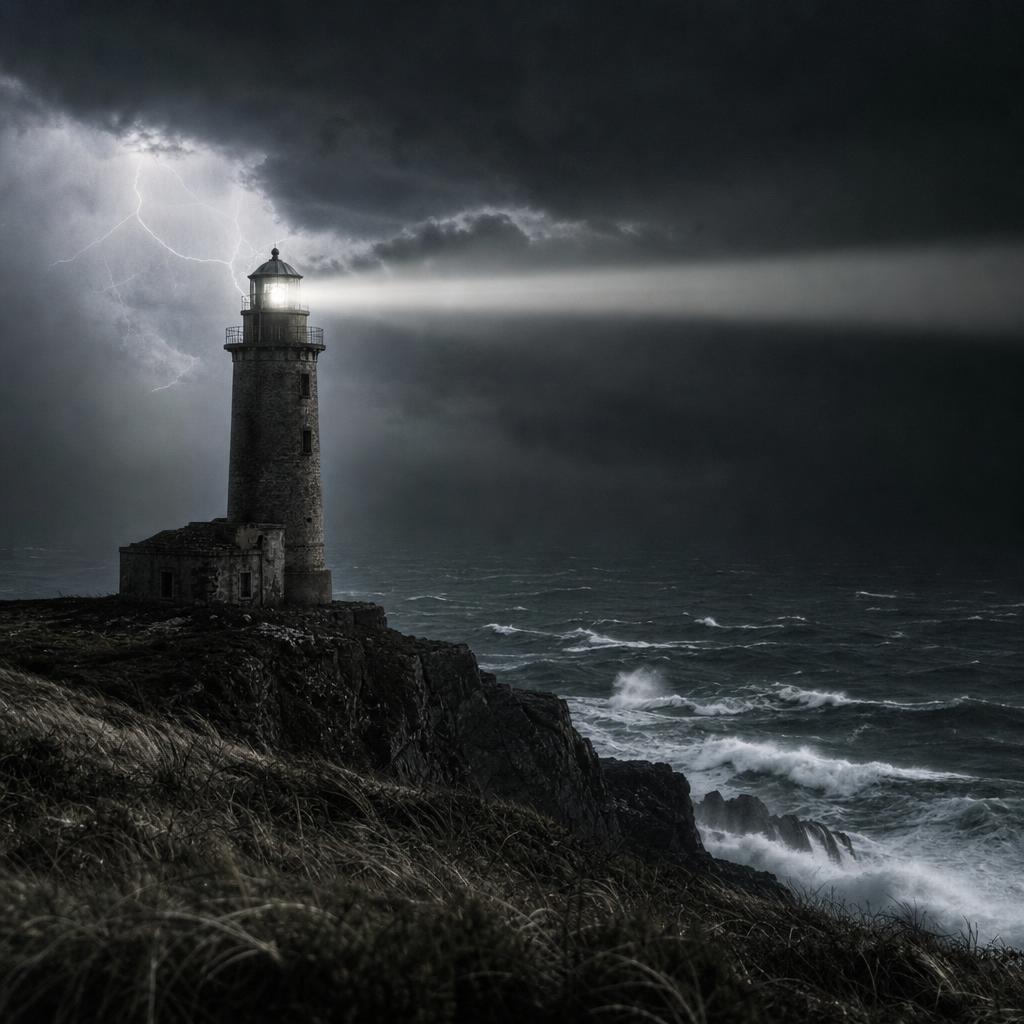
A blocked writer investigates an abandoned lighthouse whose mysterious midnight beam reveals a ship from another century.
The light had not merely returned; it carved a path through seventy-three years of silence, slicing through the Atlantic fog like a drawn blade. Below the headland, the old fishing village had long since surrendered to the tide—its timber foundations dissolved, its stone hearths buried under silt—and the approach road had surrendered to brambles, pine needles, and the steady creep of northern loam.
Yet at 11:57 every evening, the darkness on the headland gave way.
The locals in the harbor town ten miles south kept their distance, nursing a collection of tired explanations. They spoke of the last keeper, a man named Hargraves who had supposedly walked into the surf in 1953 and never walked out, doomed to scale the iron steps until the iron itself rotted away. They whispered about contraband dropped by modern offshore runs, though no vessel ever put into those jagged shoals. Mostly, they simply turned their backs to the headland when the sun went down.
Thomas Vale did not have the luxury of turning away. He had arrived on a cold October evening with a bruised leather suitcase, an iron-framed Underwood typewriter, and a week’s worth of canned provisions, seeking a solitude so total it might finally quiet the static in his head. Two years had passed since he had last finished a page. Where narrative had once flowed with the ease of an open valve, there was now only the dry, relentless ticking of his mantel clock and the terrible, blank white of unwritten paper.
He had taken the cottage on the cliff's edge specifically for its void, but on his very first night, the storm came in from the east, bringing with it a wind that rattled the glass in the sashes and drove heavy salt spray against the panes. Through the sheets of rain and the sudden, violet glare of lightning, he saw the impossible: a clean, brilliant shaft of white light cutting across the gale, swinging wide over the churning black water.
He watched it sweep, steady and deliberate, until the minute hand on his watch clicked over to midnight, at which point the coast collapsed back into total blackness.
By the fourth night, the rhythm had worked its way into his pulse. The light called to the silence in his room, demanding an answer that his own stalled mind could not provide. Driven by a desperate, nervous energy, he set out along the ruined coastal trail, fighting through tangled brush and over fallen firs until the black silhouette of the lighthouse loomed directly above him.
The iron door at the base offered little resistance, groaning on rusted hinges as he pushed his way into the damp salt air of the interior. The air inside smelled of cold stone, guano, and ancient whale oil, and while decades of grime coated the flagstones, the spiraling iron staircase was strangely clear—its center steps worn smooth and swept clean of dust.
He climbed in the dark, his hand trailing along the cold central column until he reached the lantern room at the apex.
There, surrounded by the massive, faceted glass of the Fresnel lens, stood a heavy oak desk. Upon it rested a typewriter—an older model, its iron keys gleaming faintly in the gloom—with a single sheet of heavy rag paper rolled into the carriage.
Thomas stepped forward, his boots crunching on tiny fragments of glass, and leaned over the machine. Typed neatly in the center of the page were three words:
Finish the story.
Before he could process the phrase, the mechanism beneath the lantern room engaged with a heavy, metallic thud. The gears groaned, the clockwork weights dropped within the shaft, and the great lamp burst into blinding radiance. The lens began its slow, deliberate rotation, throwing a searing beam out across the storm-tossed sea.
Thomas rushed to the glass, shielding his eyes against the glare, and looked out toward the horizon. There, suspended in the bright arc of the beam where no modern vessel should ever dare to navigate, a three-masted galeas rode the mountainous crests. Her canvas was tattered, her rigging trailing in the foam like severed veins, and her dark wooden hull bore the distinct, high-pooped silhouette of the seventeenth century. She was fighting the lee shore, her crew visible as tiny, frantic shadows against the whitewash of the deck.
The ship was not a ghost; it was an unfinished thought, suspended in the storm, waiting for a destination.
Thomas turned back to the desk. The keys of the typewriter seemed to hum under the lantern’s heat, radiating a subtle, electric warmth that reached out to his cold hands. He didn't think about the two lost years, nor the silence that had broken him, nor the impossibility of the wooden hull battling the Atlantic below.
He pulled the chair back, sat down, and laid his fingers over the home row. As the beam swept back over the dark water, illuminating the vessel once more, his hands began to move, and the sharp, rhythmic clatter of the keys rose up to meet the sound of the gale.