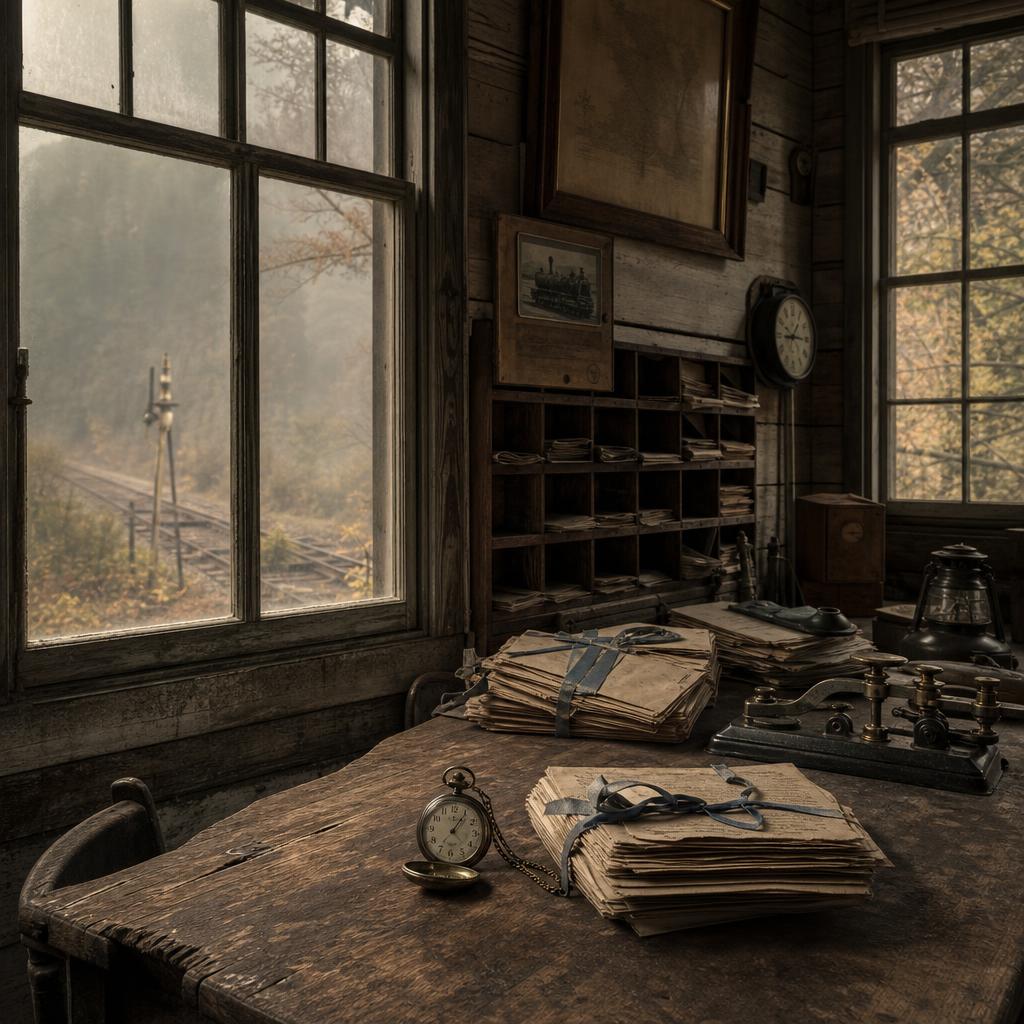
An archivist clearing an abandoned railway depot discovers letters and a pocket watch that resolve a century-old disappearance.
The morning air in Oakhaven smelled of damp earth and crushed pine needles. Arthur adjusted his canvas satchel, feeling the heavy, familiar weight of brass keys against his hip. At sixty-two, his joints registered every change in weather, and the chill settling over the ridge promised an early autumn.
He stepped onto the porch of the old town hall, where the oak floorboards yielded with a comfortable groan. For thirty-four years, Arthur had been the town’s archivist, a title that sounded far grander than his actual work. Mostly, he dusted ledger books, filed deed maps, and answered occasional questions from college students writing dissertations on 19th-century timber booms.
Today was different. The council had voted to sell the abandoned railway office at the edge of the valley, and Arthur needed to audit its historical contents before the demolition crew arrived at the end of the week.
He drove his beat-up blue pickup down the winding gravel road that led toward the old depot. Sunlight filtered through the dense canopy of birch and maple, casting dappled gold light across the dashboard. The depot had sat quiet since 1978, when the last freight line pulled out, leaving behind rusty tracks now mostly swallowed by blackberry brambles and saplings.
When Arthur arrived, the morning fog was still clinging to the timber frame of the station. The white paint was long gone, replaced by gray, weather-beaten cedar boards. Vines crept up the sides, binding the building to the landscape.
He unlocked the heavy oak door with a brass skeleton key from his ring. The lock turned reluctantly with a dry, metallic click.
Inside, time had slowed to a crawl. Dust motes floated in the beams of pale sunlight cutting through dirty glass windows. The air smelled of dry rot, old paper, and machine oil. On the main desk sat an iron telegraph key, its wiring frayed and cut. Behind the counter, row upon row of wooden cubbies held yellowed freight receipts, ticket stubs, and forgotten manifests.
Arthur rolled up his sleeves, retrieved a legal pad and pencil from his satchel, and began his inventory.
By mid-afternoon, he had cataloged four crates of track repair records and three boxes of conductor logs. It was routine work, precise and quiet.
Near the back corner of the vault room, half-hidden beneath an overturned wooden crate, Arthur found a small, iron-bound trunk. It was no larger than a shoebox, locked with a simple padlock whose latch had rusted through. He gently pried the latch open with the flat edge of a pocketknife.
Inside lay a stack of letters bound in faded blue ribbon, and beneath them, a heavy brass pocket watch attached to a braided leather strap.
Arthur picked up the watch. The brass was tarnished, but the glass crystal was intact. He turned it over and noticed an inscription etched onto the back casing:
To Thomas — Keep the time, and it will keep you. C.E., 1912.
He gently pressed the crown, and the front cover sprang open. The dial was cream enamel with black Roman numerals. Surprisingly, the hands were still set to 4:17. Out of habit, Arthur gave the crown a light turn. It offered slight resistance, then began to click cleanly.
He wound it three times.
A soft, rhythmic ticking filled the quiet vault.
Tick. Tick. Tick.
Arthur smiled, a faint wave of nostalgia washing over him. There was something remarkably resilient about old machinery.
He carefully picked up the stack of letters. The top envelope was addressed in elegant, sweeping cursive: Mr. Thomas Mercer, Station Master, Oakhaven Depot.
Arthur recognized the name. Thomas Mercer had been the station master during the First World War. Local legend held that Mercer had vanished suddenly in the autumn of 1918, leaving behind his position and his belongings without a word to anyone in town.
He untied the ribbon and unfolded the top letter, dated September 14, 1918.
Dearest Thomas,
The doctors say the fever in the camp is breaking, but the trains are running slow. I have secured passage on the northbound supply engine leaving Portland at midnight. If the tracks hold, I will arrive at the depot before dawn on Sunday. Do not leave your post.
Yours always,
Clara
Arthur read through three more letters. Clara was Thomas's fiancee, traveling back from a nursing assignment on the coast during the influenza outbreak. The last letter, dated late October, remained unopened, its seal intact.
Arthur sat on an overturned crate, holding the unopened envelope. For over a century, this final message had waited in the dark, caught between two lives that history had quietly folded away.
He hesitated, feeling like an intruder, but his archivist duty urged him forward. Using the dull edge of his knife, he slit the top edge of the envelope and unfolded the brittle paper.
Thomas,
They told me you waited at the station every night this week until the last light burned out. The train was delayed in the valley, but I am safe. I am staying at the inn in Mariposa until the road clears. If you receive this, bring the key to the watch box. I have kept my promise.
Clara
Arthur sat in the quiet vault for a long moment, the steady ticking of the brass watch keeping time against his thumb. Thomas hadn't abandoned his post out of neglect or tragedy; he had left to find her. The town records had recorded his sudden departure as a mystery, perhaps even a failure of duty, simply because no one had checked the bottom of the iron trunk.
Arthur spent the rest of the afternoon finalizing his notes. He packed the letters, the watch, and the station ledgers carefully into archival boxes, labeling each with clean, block lettering.
By the time he stepped outside, the sun was sinking behind the ridge, casting long, indigo shadows across the old tracks. The fog had returned, creeping along the valley floor like a slow tide.
He loaded the boxes into the back of his truck, locked the depot door one last time, and stood on the platform.
The council would tear the building down on Friday to make way for a new county road. The physical structure would vanish, replaced by asphalt and highway signs. But as Arthur reached into his pocket and felt the steady, gentle vibration of the 1912 pocket watch ticking against his palm, he knew the story was secure.
He drove back toward town in the gathering dusk, leaving the valley quiet behind him.