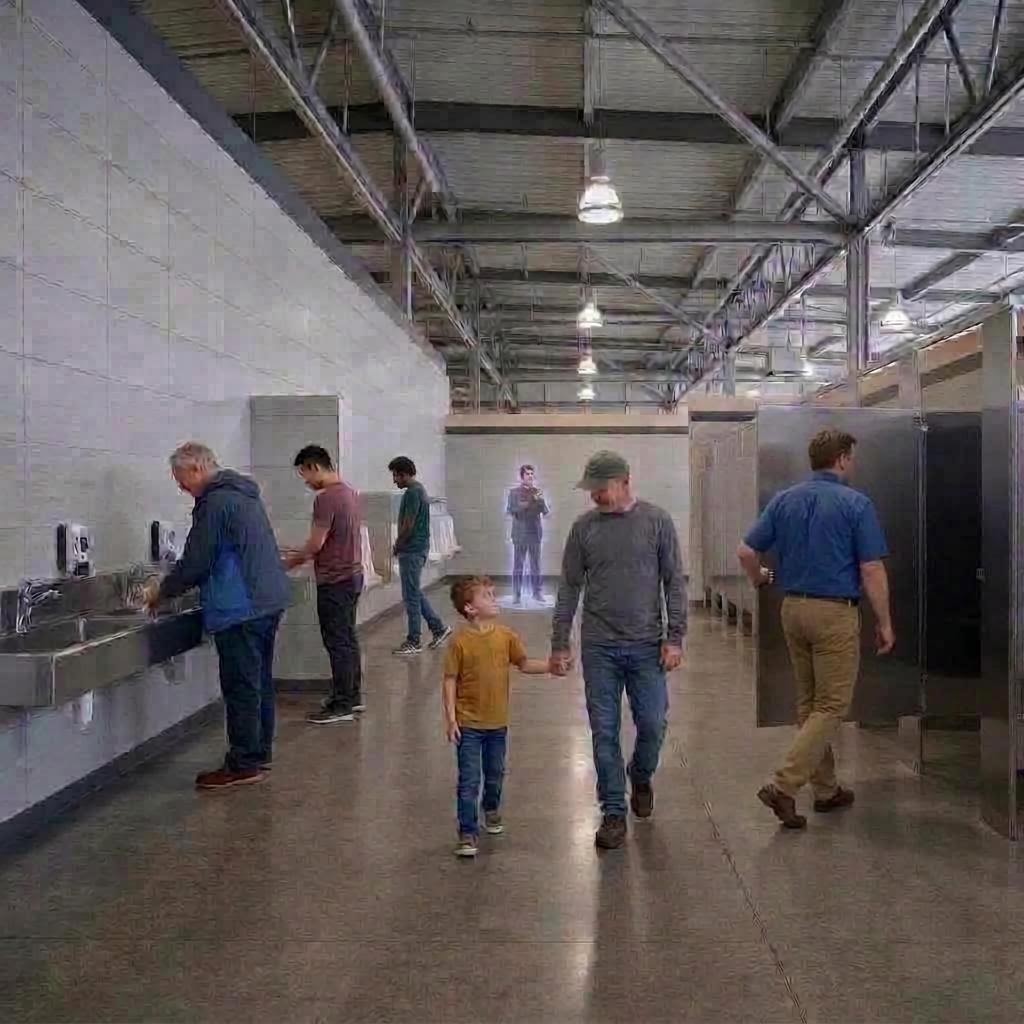
A stop on I-95, an unexpected virtual comedian, and a roomful of strangers remind a traveler that even the fastest lives need a moment to pause.
CHAPTER 1: The Pulse of I-95
The asphalt of Interstate 95 did not merely support traffic; it vibrated with a relentless, mechanical urgency. To drive on it was to participate in a high-stakes migration where slowing down felt less like a choice and more like a tactical error. On either side, heavy freight trucks roared past with a concussive WHOOSH of displaced air, their trailer walls looming like moving skyscrapers. Between them, sedan tail-lights flickered, sports cars slalomed across lanes, and motorcycles tore through gaps with high-pitched wails. Inside the car, the digital speedometer read 75, yet the flow of traffic demanded 80. The hum of the tires against the grooved concrete had long since turned into a low, hypnotic drone. Life inside the cabin had settled into a quiet truce: my wife navigating with her phone in hand, our daughter staring out the side window with headphones draped around her neck, and our dog occasionally shifting in the backseat, letting out a soft sigh whenever the car banked around a sweeping curve. Modern life had adopted this exact cadence. Everything was fast, instant, and moving forward at an exponential rate. Updates arrived on screens before thoughts could form; schedules packed themselves into wall-to-wall obligations; even leisure felt hurried. Then came the sign, gleaming under the afternoon sun: REST AREA — 1 MILE. The turnoff lane offered a sudden, almost jarring deceleration. Stripping away fifty miles per hour in a matter of seconds felt like stepping off a moving sidewalk. As the car rolled up the long, tree-lined access road toward the parking lot, the noise of the highway softened into a distant rumble. We pulled into a parking space near the edge of the lot. The engine shut off, and an absolute silence took over the cabin for a brief second before the doors swung open. My wife unbuckled the dog’s harness and stepped out onto the grass verge with our daughter, both of them stretching their arms toward the sky with relieved groans. The dog immediately put his nose to the grass, sniffing furiously at the countless invisible tracks left by hundreds of other travelers who had paused here before us. "We'll take the dog around the grass first, then head in," my wife said, waving a hand toward the main entrance. "Go ahead." I stepped out onto the pavement. My knees popped as I straightened up, feeling the stiffness that accumulates after hours behind the wheel. The air outside was cool and smelled faintly of damp pine needles and hot exhaust. Ahead stood the main building—a massive, cavernous complex guarded by heavy industrial entrance doors, standing as a solid, cavernous vault along the asphalt corridor.
CHAPTER 2: Sanctuary of Iron, Concrete, and Light
Passing through the massive industrial entrance doors felt less like entering a roadside building and more like stepping into a vast, modern hangar. The heavy-duty doors slid back with a low, mechanical hum, opening up to a wide, open-span interior built to handle endless waves of weary travelers. Inside, the rest area was an immense, cavernous space with polished concrete floors that reflected the overhead high-bay lighting. Massive steel beams stretched across high, vaulted ceilings, giving the expansive facility a rugged, industrial cathedral-like atmosphere that seemed entirely incongruous with its humble purpose. Despite the steady stream of travelers moving through this sprawling hall, there was an unwritten order to the room. It was populated by a cross-section of modern society: tired parents guiding sleepy toddlers by the hand, teenagers tapping at their phones while leaning against vending machines, long-haul truckers walking with the measured, heavy stride of men who lived on the road, and retired couples wearing matching windbreakers, taking their time as they studied the state tourist maps pinned to the bulletin boards. Everyone was engaged in the same basic, inescapable human routine. Strip away the titles, the careers, the vehicle makes, and the hurry of the road, and everyone inside this massive space was reduced to simple biology and the shared need for a moment's comfort. I walked across the vast expanse toward the men's facility. The heavy, industrial-framed doorway led into a sprawling tiled restroom that echoed loudly with sound. Row upon row of immaculate stainless-steel stalls stretched down one side, while a long line of porcelain urinals ran along the opposite wall. The room was bustling—at least a dozen men were present, each maintaining that subtle, unspoken protocol of public restrooms: eyes kept straight ahead, personal space carefully respected, and conversation kept to zero. I approached an open urinal near the center of the wall, stepped up, and began to concentrate, welcoming the physical relief after hours of driving. That was when the surreal set in.
CHAPTER 3: The Virtual Comedian
As I stood there, my gaze naturally settled on the far end of the room. Positioned at the end of the space was a sleek virtual comedian that I hadn't noticed upon entering. A digital avatar—a virtual stand-up comedian rendered in vivid, saturated colors—was midway through a performance. The comic moved with slick, animated gestures, holding a microphone and pacing back and forth across a virtual stage. His voice boomed softly through small, directional overhead speakers, pitched just loud enough to carry across the tile without being deafening. “Welcome to Rest Area 51! We don’t hide aliens here—just dads who said, ‘We can make it to the next exit.’” A quiet snort echoed from a man two stalls down. The comedian didn't pause for breath. “My GPS says, ‘Continue for seventy miles.’ My bladder says, ‘That’s adorable.’ Guess which one just got promoted to head of navigation?” A louder chuckle rippled down the row of sinks. An elderly man washing his hands grinned into the mirror. “A rest stop is the only place where a millionaire and a truck driver have exactly the same problem: the guy in front won’t hurry up.” What struck me was the fascinating duality of the scene. Everyone in the facility clearly heard the comedy routine; their slight nods, smirked lips, and relaxed shoulders gave it away. Yet, as I looked around, I seemed to be the only person actually looking up and directly watching the virtual comedian. Everyone else was keeping their eyes firmly glued to the tile in front of them, adhering strictly to the unwritten rules of restroom etiquette while soaking in the comedy through passive ears. “This soap smells like lavender and ocean breeze. Wonderful. I’ve been driving six hours, and now my hands are having a better vacation than I am!” the avatar joked, leaning in toward his virtual mic. “That hand dryer has the power of a jet engine. It shakes your sleeves, loosens your wedding ring, and somehow leaves one finger completely wet.” “I waved at the faucet. Nothing. I danced. Nothing. The guy beside me got water immediately. Apparently, this sink has a favorite child.” “The vending machine took my money and kept the chips. I shook it, and it blinked ‘Thank you.’ That’s the politest robbery I’ve ever experienced.” The sounds of the room formed a strange, chaotic symphony. The comic’s punchlines and light canned laughter merged seamlessly with the ambient noise of the facility: the deep, reverberating roar of automatic flush valves, the hiss of motion-activated water faucets, the high-pitched whine of electric hand dryers, and the occasional uninhibited rumble of human gas. It was bizarre, hilarious, and profoundly human. Here, in the most mundane and private of public settings, modern technology had introduced a virtual entertainer to perform for an audience engaged entirely in their most basic bodily functions. The comedian wrapped up his set with a flourish, stepping toward the center of his virtual stage and pointing directly outward. “Thanks, folks! Drive safely, check your mirrors, and remember: ‘I don’t need to go’ is not a medical diagnosis. It’s how we end up here.” The virtual comedian faded away, leaving the room to return to its rhythmic chorus of flushes and running water.
CHAPTER 4: The Speed of Life
I finished, washed my hands at the automated sinks, and dried them under the warm blast of the air dryer. Walking back out through the immense industrial entryway, I passed through the heavy doors and met my wife and daughter coming out of the women’s facility, looking refreshed. Together, we walked out into the open air. Clarence had already done his business. He greeted us with a wagging tail, his leash tied securely to a post at the edge of the grass. My wife untied the leash and led him back to the car. We loaded back in, securing the dog in his harness and clicking our seatbelts into place. Before turning the key in the ignition, I sat quietly for a moment with my hands resting on the steering wheel. I looked out through the windshield at the highway just beyond the parking lot and shoulder. From our parked position, the view of I-95 was startling. Big rigs, delivery vans, passenger cars, and loud motorcycles blurred past in an unbroken ribbon of motion. Seeing the traffic from a stationary viewpoint made its true velocity apparent. It looked furious, relentless, and dizzying. Sitting there in the stillness of the parking lot, a realization took hold. The speed of life outside this parking lot was not going to slow down. Technology, communication, travel, expectations—everything was moving toward a future that demands greater acceleration every single day. The world pushes us to move faster, produce more, travel quicker, and react instantly. And yet, true relief—true renewal—came from the deliberate act of breaking away. It came from pulling off the highway, stepping through heavy industrial doors into a cavernous, brightly lit space with strangers of all ages, hearing a virtual comedian crack jokes over the sound of flushing toilets, and simply taking a breath. A rest stop like "Rest Area 51" wasn't just a physical necessity; it was a psychological sanctuary. It was a reminder that no matter how fast the world outside moves, human beings still need to pause, stretch, laugh, and reset. I turned the key, and the engine hummed to life beneath us. I eased the car out of the parking space and onto the on-ramp, watching the digital dashboard light up. As I accelerated up the ramp, matching the speed of the roaring traffic, my eyes caught a small, yellow highway sign posted right at the final curve before merging: "MERGING TRAFFIC: NO MATTER HOW FAST YOU GO, YOU CAN'T OUTRUN YOUR GAS TANK—OR YOUR BLADDER!" I chuckled aloud, checked my side mirror, hit the blinker, and seamlessly merged back into the high-speed stream of I-95—relieved, renewed, and ready for whatever speed lay ahead.