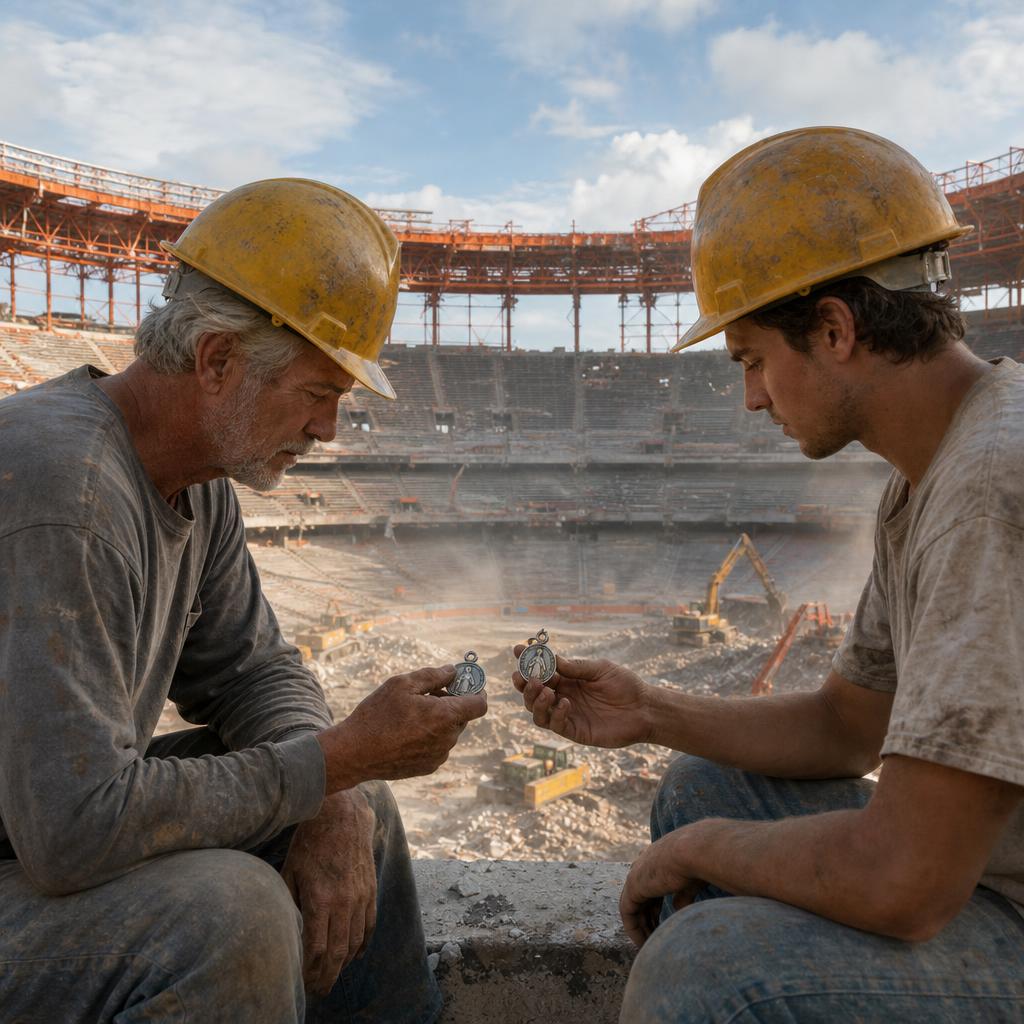
Amid the demolition of the Miami Orange Bowl, two coworkers discover a connection neither expected.
Chapter 1: The Echoes of Concrete
The high sun beat relentlessly down on the sun-bleached superstructure of the Miami Orange Bowl. Heavy demolition machinery roared across the dirt footprint where legendary games had been played, filling the humid afternoon air with a thick haze of pulverised concrete, rust, and exhaust. Hydraulic shears tore through decades of corrugated steel, sending sharp metallic groans echoing through the hollowed-out cavern of the upper decks.
Among the demolition crew assigned to Section 32 was Luis Vance. At fifty-eight, Luis was a veteran of the heavy trades—his skin weathered like aged leather, his silvered hair tucked neatly under a beaten yellow hard hat. He worked with a quiet, practiced rhythm, swinging a sledgehammer and guiding pneumatic saws to break apart structural overhangs before the giant cranes took hold.
Working alongside Luis for the past three weeks was Leo. At twenty-six, Leo was reticent and focused, keeping his head down and his gloves moving. He had joined the crew as temporary contract labor when the stadium demolition phase accelerated. Though they had spent hours side by side in the dusty heat, their interactions had been confined strictly to hand signals, warnings about unstable footings, and short operational directives.
As the site horn sounded for the mid-day break, the deafening mechanical thunder subsided into a sudden, ringing silence. The crew scattered toward shaded staging areas below. Luis and Leo remained up high, sitting on a bare, exposed concrete beam overlooking the stripped field where decades of football history were being erased hour by hour.
Luis unbuckled his tool belt, leaning back against a steel support pillar. He took a long drag from his water thermos, watching the young man beside him adjust his dusty work shirt. As Leo pulled at his collar to wipe away sweat, a thin brass chain slipped out from beneath his shirt, swinging into the sunlight.
Suspended from the chain was a worn, silver medallion—an uncommon antique piece depicting a delicate, high-relief guardian angel with folded wings.
Luis’s thermos froze halfway to his mouth. His eyes locked onto the metal disk. The air in his lungs suddenly felt as heavy as the concrete around them.
"Where did you get that medal?" Luis asked, his voice unexpectedly raspy through the quiet.
Leo instinctively reached up, wrapping his thumb around the silver piece and tucking it back under his collar. "It's personal," Leo replied neutrally, looking out over the empty field.
"I know it's personal," Luis said, leaning forward, his hands trembling slightly as he set his thermos down. "Please. That's an old St. Jude guardian piece. They were only cast in a small shop in Little Havana back in the early eighties. Where did it come from?"
Leo looked at the older man, caught off guard by the intensity in Luis’s eyes. "My adoptive parents gave it to me," Leo said slowly. "They said it was pinned to the blanket inside my bassinet at the hospital when I was born."
Chapter 2: The Name in the Dust
Luis sat motionless, the blood draining from his face until he appeared as pale as the dust coating his boots. He closed his eyes for a long moment, breathing in the sharp scent of ozone and crushed stone.
"What was the name on the hospital intake record?" Luis asked quietly, almost afraid of the answer. "Before the adoption papers were finalized?"
Leo frowned, adjusting his hard hat. He had never discussed his background on a job site before, but there was no malice in the older man's voice—only a raw, desperate gravity.
"Vance," Leo said. "Leo Vance."
Luis reached with a shaking hand into his left shirt pocket. He pulled out a small leather pouch, worn smooth by years of handling. From inside, he drew a matching silver medallion—identical in weight, metal, and hand-carved detail, right down to the nick on the lower left wing where the silver casting had cooled unevenly.
He held it out in his open palm.
Leo stared at the coin in Luis's hand, then slowly pulled his own necklace back out into the light. He held the two pieces side by side. They were unmistakable pairs, cast from the same mold, bound by the exact same history.
"My name is Luis Vance," the older man whispered, tears cutting clear tracks through the grey dust on his cheeks. "I didn't abandon you, Leo. I spent twenty-six years wondering if you were even alive."
Leo stood up abruptly, taking a step back on the concrete girder, his hands clenching into fists. The noise of his own pulse thundered in his ears louder than the demolition machinery. "What are you talking about? My records said my biological father surrendered custody at birth."
"Sit down," Luis begged softly, keeping his hands open and visible. "Please. Just listen to me for five minutes. If you want to walk away down those stairs and never look at me again, I won't stop you. But you deserve the truth."
Leo remained standing for several seconds, his jaw tight, staring at the silver medallion in his hand. Slowly, he lowered himself back onto the beam, keeping his distance, his heart hammering against his ribs.
Chapter 3: Winter of 1982
Luis looked out across the skeletal remains of the stadium, his mind traveling back more than two decades to a dark, narrow apartment near Jackson Memorial Hospital.
"It was November of 1982," Luis began, his voice steadying as the memory surfaced. "Your mother, Elena, and I were young. We had almost nothing, but we were happy. When she fell pregnant with you, we bought those two medals from a local chapel. We were going to keep one and put the other around your neck the day you came home."
Luis wiped his face with the back of his sleeve. "Complications started during labor. It happened so fast the doctors couldn't stop it. Elena... she suffered severe hemorrhaging. She died in the delivery room less than twenty minutes after you were born."
Leo sat completely still, listening as the story he had spent a lifetime guessing at finally began to take shape.
"I broke down," Luis continued. "Within forty-eight hours of losing her, I collapsed at home. My lungs filled up with fluid—a severe double pneumonia brought on by shock and infection. I was admitted to the intensive care unit on mechanical ventilation. I lost consciousness for nearly three weeks."
Luis pointed toward the medical center towers visible on the Miami skyline beyond the stadium's broken rim. "While I was unconscious, hospital social services had to make a determination. I had no living relatives in the state, no savings, and the doctors told the social worker there was a strong chance I wouldn't survive the illness. When I finally woke up in late December, weak and broke, the emergency custody process was already complete."
He looked directly into Leo's eyes. "I tried to fight it. I spent every penny I had on legal assistance, but the state ruled I was physically and financially incapable of providing a home. The adoption had been expedited to a good family. The only thing the social worker allowed me to pass along to your adoptive parents was that silver medallion."
Chapter 4: The Path to Section 32
Leo listened to the hum of the city beyond the concrete walls. For twenty-six years, he had lived with the silent, lingering assumption that he had simply been unwanted—an inconvenient burden left behind at a hospital desk. To hear the reality laid bare amidst the rubble of the Orange Bowl shattered a quarter-century of false assumptions.
"My parents... my adoptive parents," Leo said, his voice quiet, "they always told me my birth father loved me. They said he left the medal so I’d know I wasn't forgotten. I never fully believed them. I thought they were just trying to soften the blow."
"They were telling you the truth," Luis said. "I looked for you for years, Leo. But closed adoption laws back then were an absolute vault. After a while, I had to force myself to stop searching—not because I stopped loving you, but because I hoped you were living a safe, happy life with a family who could give you everything I couldn't."
Leo looked down at his calloused hands, then at the silver guardian angel in his palm. He thought about his upbringing, his solid adoptive home, and the winding path that had unexpectedly led him into heavy construction six months ago.
"I took this job three weeks ago because my primary contractor ran out of work," Leo said, a faint smile breaking through the shock on his face. "I wasn't even supposed to be assigned to the Orange Bowl site. They transferred me over from the port project at the last minute."
"And I was supposed to retire last autumn," Luis said quietly. "My foreman begged me to stay on for one last major structure before I turned in my badge."
The two men looked around at the decaying stadium. Millions of people had passed through these turnstiles over the decades, shouting for victories, sharing moments in the stands. Yet of all the places in the city, two men tied by blood and tragedy had been assigned to the exact same thirty-foot section of upper-deck concrete on a Monday afternoon in Miami.
Chapter 5: Standing in the Rubble
The heavy horn sounded across the demolition site, signaling the end of the lunch break. Below them, diesel engines coughed to life, and the heavy iron jaws of the excavator resumed their work, crunching through a lower seating tier.
Luis stood up carefully, wiping the dust from his trousers. He looked at Leo, suddenly cautious, aware of the delicate boundary between them.
"I don't expect you to treat me like a father overnight," Luis said gently. "You have a family, and you have your own life. But I wanted you to know the truth. You were loved from the very second you were born."
Leo stood up slowly, looking at Luis—not as a stranger or a crewmate, but as a man who had carried a heavy weight of grief and memory for twenty-six years without ever laying it down.
Leo reached out, taking his own medallion off his neck. He held it out toward Luis. "Can you help me fix the clasp? The chain broke last week, and I've been meaning to repair it."
Luis looked at the chain, then up at Leo's face. A deep, quiet relief settled across the old man's shoulders.
"Yeah," Luis said, his voice warm and steady. "Yeah, I can fix that for you after our shift."
Chapter 6: Orange Bowl Forever
As the afternoon light began to turn golden across the Miami skyline, Luis and Leo worked side by side through the final hours of the day. The thunder of heavy machinery surrounded them, but the heavy isolation that both men had carried for decades was gone.
They cleared steel rebar together, guided heavy loads to the cranes, and shared small details about their lives during the brief lulls in work. Leo learned about his mother's smile and her love for the ocean; Luis learned about Leo's passion for mechanical restoration and his quiet life in the suburbs.
By 5:00 PM, the site master cut power to the heavy rigs. The dust began to settle over the ruined field, bathed in the soft orange glow of the setting Florida sun.
They walked down the long, temporary scaffolding stairs together, their boots crunching on the loose gravel at the base of the stadium. At the gate, workers were clocking out, filing toward the parking lot where rows of pickup trucks sat in the dust.
Luis turned toward his truck, then paused, looking back at Leo. "Are you hungry? There’s a quiet diner down on Calle Ocho. Best Cuban sandwiches in the city."
Leo pulled his hard hat off, running a hand through his hair, and looked back one last time at the iconic orange steel frame rising against the twilight sky. The historic landmark was falling piece by piece, but standing in its shadow, something permanent had taken its place.
"Lead the way," Leo said with a warm smile. "I'll follow you down."