After a quiet morning changes everything, Selma must choose between a peaceful reunion and the grandson who still needs her.
Chapter 1: Morning Light and Scrambled Eggs
The kitchen clock ticked with a heavy, deliberate rhythm that belonged to another era. It was a sturdy brass thing, mounted on wallpaper patterned with faded yellow roses, and every swing of its pendulum seemed to steady the foundation of the house itself.
To ten-year-old David, that kitchen was the center of the universe. The linoleum under his bare feet was worn smooth in front of the sink, and the smell of butter, coffee, and faint lavender soap was as permanent as the oak trees in the front yard. At the middle of it all was Selma.
"Sit up straight, David, or your toast will drop butter right on your clean trousers," Selma said without turning around. She had an extraordinary ability to see through the back of her head, a power David had ceased questioning years ago.
She was a woman built of quiet resilience, with hair the color of spun pewter pinned back in a neat twist. Her hands, though marked by soft blue veins and the wrinkles of seventy-two years, moved with practiced grace over the cast-iron skillet.
"I’m sitting straight, Grandma," David mumbled, his voice thick with sleep. He leaned his chin on his palm, watching the steam curl up from his mug of hot cocoa.
"You’re slumping, sweetheart. Up now." Her hand touched his shoulder—warm, dry, and reassuring.
She plate-served his breakfast: two scrambled eggs, bright yellow and soft, alongside a strip of crisp bacon and a piece of white toast cut neatly into triangles. She sat across from him with her own cup of black coffee, watching him eat with a quiet, watchful affection.
Ever since David’s parents had passed when he was just a toddler, Selma had been his whole world. She was his teacher, his nurse, his chef, and his quiet audience. There was no mother’s soft touch or father’s booming voice in the house, only Selma’s steady presence, which seemed large enough to fill every empty corner.
"Got your history folder?" she asked, glancing at the blue canvas backpack resting against the leg of the table.
"Packed last night," David said around a mouthful of toast.
"And the permission slip for the science center?"
David paused, his fork hovering mid-air. "Uh..."
Selma chuckled, a low, gentle sound that crinkled the corners of her eyes. She reached into the pocket of her faded floral apron, pulled out a folded slip of paper signed neatly in her precise, cursive script, and slid it across the oilcloth table. "I put it in your folder after you fell asleep. Honestly, David, if your head wasn't attached to your shoulders..."
"I would've left it on the bus," David finished for her, grinning.
"You certainly would."
From down the lane came the distant, unmistakable rumble of a heavy diesel engine. The morning school bus was making its way up the winding rural road, stopping at every farm lane along the ridge.
"Right on time," Selma said, standing up. She took his empty plate to the sink with a swift efficiency that belied her age. "Up you get. Shoes on."
David tied his sneakers in quick, sloppy double-knots, hoisted his heavy backpack onto his shoulders, and let his grandmother open the heavy oak front door for him. The morning air was crisp, scented with pine needles and damp earth.
They walked together down the gravel path to the wooden mailbox at the edge of the road. Selma wrapped her arms around herself against the morning chill, her apron fluttering slightly in the breeze.
The yellow bus rounded the bend, its brakes squealing as it ground to a halt. The folding doors hissed open, revealing the cheerful, tired face of Mr. Henderson, the driver.
"Morning, Mrs. Selma! Morning, David!" Mr. Henderson called out.
"Good morning, Arthur," Selma replied, her voice clear. She placed a hand on David’s back, giving him a gentle nudge toward the accordion doors. "Be good today, David. Pay attention to your teacher."
David climbed the rubber-treaded steps, turning back at the top step to offer a quick wave. "Bye, Grandma!"
"Goodbye, my sweet boy," she said.
Selma stood at the mailbox, watching as the yellow bus pulled away, its red taillights glowing through the morning mist until it vanished around the curve of the hill. She smiled to herself, enjoying the quiet stillness of the countryside, before turning around to walk back up the path toward the lonely house.
Chapter 2: The Silent House
The silence inside the house after the bus departed was always absolute. It was not a sad silence, but a profound stillness that allowed the old building to settle into its bones.
Selma closed the heavy front door and latched it. The warmth of the kitchen greeted her, still smelling of butter and roasted coffee beans. She wiped down the counter with a damp rag, rinsed David’s plate, and stood at the sink for a long moment, looking out the small window over the yard.
A blue jay landed on the wooden bird feeder she and David had built last spring. She smiled, watching the bird peck at the sunflower seeds.
Then, without warning, the floor beneath her feet seemed to lose its solidity.
It did not feel like a sudden fall, nor like the violent spinning of dizziness. It was as though the density of the world had abruptly vanished. Her right hand, holding the damp dishcloth, relaxed completely, letting the cloth slip into the stainless steel sink with a soft, silent thud.
"Oh," Selma whispered into the quiet kitchen.
A coldness swept up from her ankles, moving rapidly through her legs and into her chest. It was not the cold of winter, but a profound, draining sensation—as if her heart had simply decided to slow its steady rhythm down to a whisper, then to a flicker, and then... to nothing at all.
Her knees buckled, but she did not crash into the linoleum. Instead, her body slid gently down against the lower kitchen cabinets, settling onto the braided rug in front of the sink. Her eyes remained slightly open, fixed on the blue jay outside the window, though the blue of the bird and the green of the trees were rapidly washing out into a brilliant, featureless white.
The ticking of the brass clock on the wall began to slow.
Tick...
...tick...
......tick.
The interval between the sounds stretched into infinity until the sound itself ceased to exist. The physical world—the kitchen, the smell of coffee, the faint hum of the refrigerator—dissolved like salt in warm water.
Selma was no longer sitting on the floor of her kitchen. She was no longer old. She was no longer tired.
Chapter 3: Beyond the Horizon
Where the kitchen had been, there was now light.
It was not the harsh glare of the sun, nor the cold artificial light of a hospital room. It was a radiant, living brightness that seemed to emanate from everywhere at once, filling every dimension of her consciousness. It carried a warmth that seeped into parts of her spirit she hadn't realized were cold.
Selma felt weightless. The chronic ache in her lower back, the stiff arthritic swelling in her knuckles, the heaviness in her chest that had lingered for years—all of it was gone, stripped away like an old coat no longer needed.
She was standing, though there was no ground beneath her feet, only a vast, serene expanse that stretched endlessly in every direction. The atmosphere was charged with a deep, vibrating peace—a harmony so complete that it felt like a music played too softly for human ears to hear, yet loud enough to fill the universe.
In the distance, across what felt like a meadow woven from pure gold and soft mist, figures were moving. They were radiant, familiar shapes.
Selma recognized the easy, rolling gait of her husband, Thomas, who had been gone for nearly twenty years. Beside him stood her daughter—David’s mother—her laugh echoing like silver bells across the expanse. They were waiting for her, their arms half-raised in welcome, their faces glowing with a joy that knew no sorrow, no time, and no ending.
"Thomas..." Selma thought, though she spoke no words. Her heart swelled with a longing so intense it nearly carried her forward across the threshold.
Here was rest. Here was the reunion she had prayed for during long, lonely nights in an empty house. Here was a place where pain could not follow, where age had no meaning, and where love was the very air she breathed.
She took a step toward them, feeling the golden light wrap around her like a warm embrace. Thomas held out his hand. Her daughter took a step forward, her eyes shining with unconditional love.
Everything within Selma urged her to run to them, to surrender to the incredible peace that surrounded her, to let go of the heavy, fragile earthly shell she had left behind in the kitchen.
Then, from somewhere impossibly far away—farther than the stars, beyond the boundaries of this luminous world—a sound reached her.
It was not a voice, but a memory of a sound. It was the squeak of sneakers on linoleum. It was the rustle of a blue canvas backpack being dropped on a chair. It was a young boy’s voice asking, “Grandma, what’s for snack?”
Selma stopped.
She looked back over her shoulder, though there was no door behind her, only the infinite golden light.
Chapter 4: The Anchor
In that quiet realm, time did not move in a straight line, but Selma knew with absolute clarity what lay on the other side of the veil.
She saw David. Not as a memory, but as a living truth. She saw him sitting alone in an empty house, staring at a cold kitchen floor. She saw the confusion in his ten-year-old eyes, the sudden, terrifying realization that the only anchor in his storm-tossed world had been ripped away. She saw the years stretching out ahead of him—the middle school graduations, the first heartbreaks, the quiet evenings without anyone to make him toast or sign his permission slips.
He was too young. The world was too big, too sharp, and too cold for him to walk through it alone just yet.
Selma turned back toward Thomas and her daughter. They had stopped moving toward her. They stood in the golden haze, watching her with deep, understanding eyes. There was no disappointment on Thomas’s face, only a profound, timeless patient love. He smiled, nodded slowly, and stepped back alongside their daughter.
"Not yet," Selma whispered to the light. "He still needs me."
The decision was not painful; it was absolute. Her love for her grandson was an anchor dropped into the deepest bedrock of creation, pulling her back with a force stronger than the peace of heaven itself.
The radiant meadow began to recede. The golden light softened, contracting into a single point of brilliance. The deep, harmonious music dissolved back into silence.
...tick...
..tick..
Tick.
The rhythm of time snapped back into place like a stretched rubber band releasing.
A sharp, ragged breath rushed into Selma’s lungs. Her eyes opened wide. The white light vanished, replaced by the yellow-rose pattern of the kitchen wallpaper.
She was sitting on the braided rug, her back pressed against the lower cabinets. The linoleum was cold against her legs. The sink was above her, and in it lay the damp dishcloth she had dropped. Outside the window, the blue jay flew away into the morning air.
Selma sat motionless for a long time, her hand resting over her chest. Beneath her ribs, her heart was beating again—slowly, steadily, carrying the heavy weight of life once more.
She took another deep breath, grounded herself against the wooden cabinet, and slowly, painstakingly pushed herself up to her feet. Her knees creaked. Her hip ached with its familiar, dull throb.
She reached into the sink, picked up the damp rag, and wrung it out over the drain. Then she picked up her coffee cup, carried it to the table, and sat down in her chair by the window to wait for the afternoon.
Chapter 5: 3:15 PM
The afternoon passed in a quiet blur of routine. Selma swept the kitchen floor, folded a load of laundry from the dryer, and set a pot of water on the stove to boil. To anyone looking through the window, she was simply an old woman tending to her home on a quiet Tuesday. Her hands did not shake as she peeled potatoes for dinner; her voice was calm as she hummed an old hymn under her breath.
Yet, deep within her chest, something had fundamentally shifted. The fear of death, which haunts every human life in quiet moments, was entirely gone. She had seen the other side. She knew what waited for her when her work was finally done. But until then, her work was right here.
At 3:12 PM, Selma pulled a plate of fresh peanut butter cookies out of the oven and set them on a wire rack to cool.
At 3:15 PM, the heavy crunch of gravel signaled the return of the school bus.
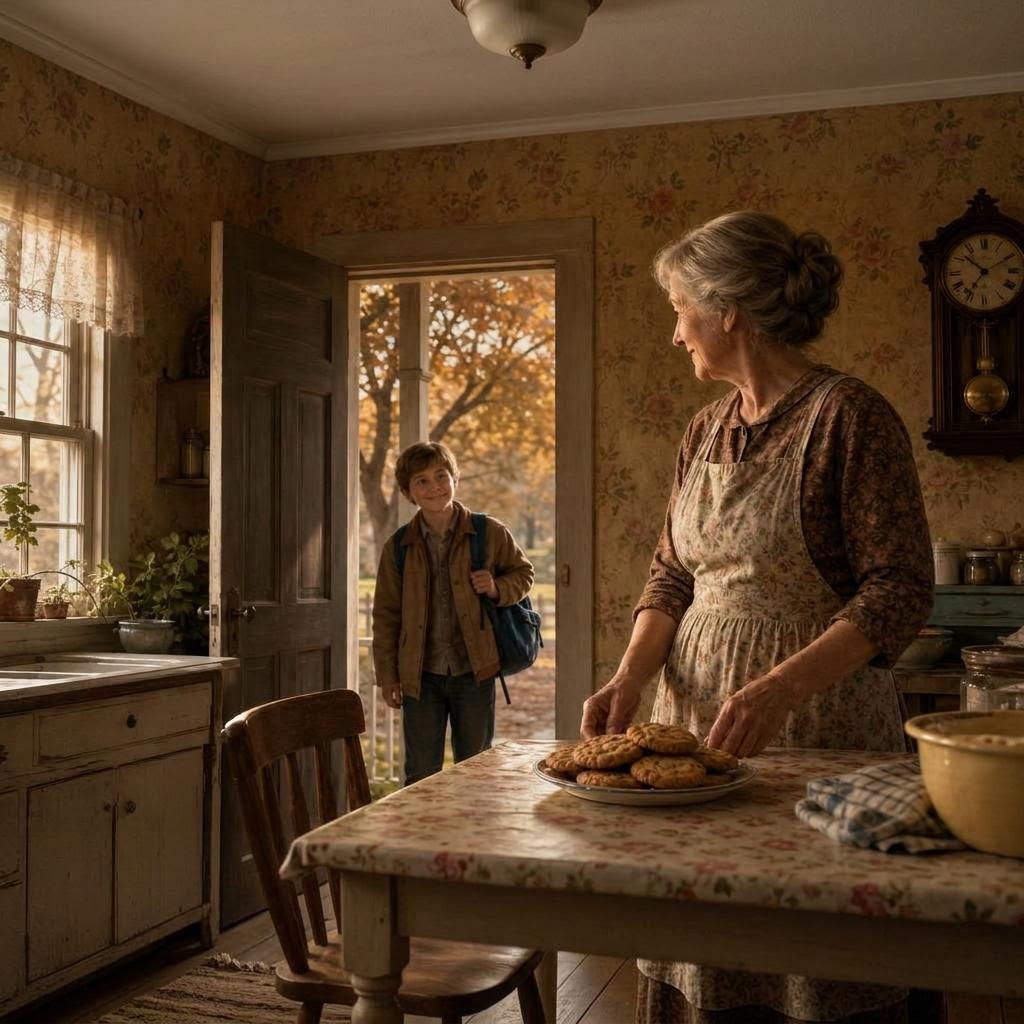
Selma stepped to the front window and watched through the lace curtains as the yellow bus ground to a halt at the gate. The folding doors opened, and David hopped down onto the gravel, his backpack slung loosely over one shoulder, his jacket unbuttoned and flapping in the wind.
He ran up the path, his sneakers kicking up tiny stones, his face bright with the eagerness of a child returning to a safe harbor.
The front door swung open with a bang.
"Grandma! I'm home!" David called out, kicking off his shoes in the hallway with customary carelessness.
Selma emerged from the kitchen, tying her apron securely around her waist. Her hair was perfectly pinned, her smile as warm and steady as the morning sun.
"Welcome home, sweetheart," she said, her voice rich and grounded. "How was your day?"
"It was awesome!" David said, bursting into the kitchen and dumping his heavy backpack onto the table. "Mr. Henderson almost missed the turn by the creek, and in science, we got to look at pond water under a real microscope! There were these tiny little bugs swimming around in circles!"
"Is that so?" Selma asked, sitting down across from him and sliding a plate of warm cookies toward his place. She reached out and smoothed down the stubborn cowlick on the top of his head.
"Yeah! And Billy lost his lunchbox, but we found it under the bleachers." David grabbed a cookie, taking a big bite, his cheeks puffing out as he chewed. "What did you do all day, Grandma?"
Selma looked at him—at his bright, curious eyes, the smudges of pencil lead on his fingers, the complete and total security in his expression.
She smiled, a quiet, luminous smile that held the warmth of a thousand suns.
"Oh, nothing much, my sweet boy," Selma said softly, reaching out to pat his hand. "Just got the house ready for you to come home."