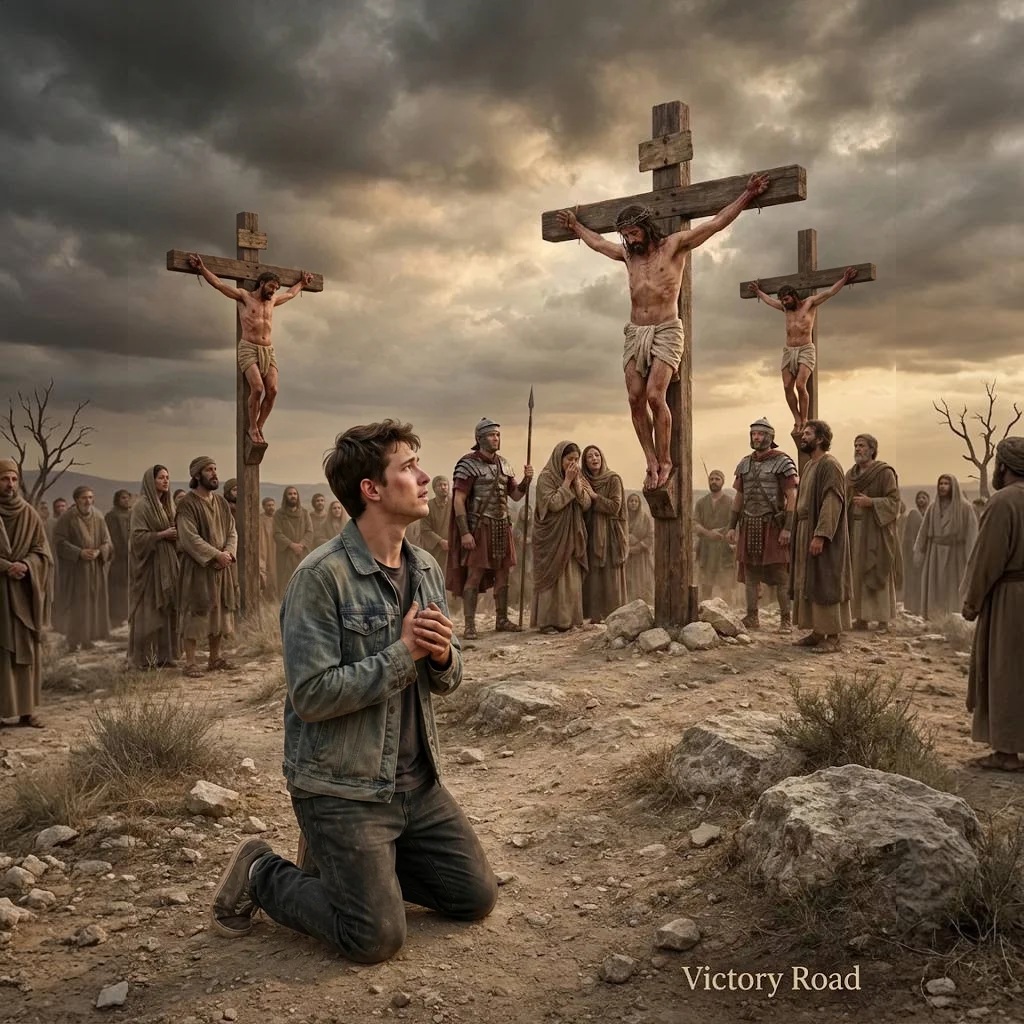
A modern young man finds himself at Golgotha, where an encounter with Jesus challenges his bitterness and opens a path toward forgiveness.
Chapter 1: The Weight of Dust and Denim
The gravel beneath Leo’s shoes felt nothing like the asphalt of the city he had left behind, and the familiar hum of distant traffic was gone. Instead, the wind smelled of dry earth, copper, and woodsmoke. Leo looked down at himself. He wore the same faded denim jacket that had seen him through three winters, a charcoal T-shirt frayed at the collar, and dark jeans stained with the dust of a thousand aimless miles. Gravel crunched beneath his scuffed, thin-soled sneakers as he climbed the rocky slope. Around him, a sea of people moved and murmured in coarsely woven tunics, dusty cloaks, and leather sandals. Roman soldiers stood in rigid formations, their bronze and iron armor glinting dully beneath a bruised, darkening sky. Leo was an anomaly—a ghost from two millennia in the future standing in the middle of Golgotha. Yet, as he walked through the crowd, no one recoiled. A woman weeping into her shawl brushed past his denim sleeve without a glance. A centurion resting a hand on the pommel of his sword looked right through Leo’s modern silhouette as if his faded jeans and worn sneakers were the most natural things in the world. There was no judgment in their eyes, no shock at his strange attire. In this place of profound sorrow and chaos, Leo was simply another soul drawn to the hill.
Chapter 2: The Ascent
The hill was steeper than it looked from below, and the crowd grew denser near the summit. The air was thick with tension—a mixture of grief, anger, and cold indifference. Leo kept his hands shoved deep into his jacket pockets, feeling the familiar, heavy weight of the bitterness he had carried for years. He had come here—however he had arrived—feeling entirely hollow, worn down by regrets, anger, and a life that felt perpetually stuck in the mud. He pushed forward until the crowd thinned at the crest of the hill. Three wooden crosses stood against the turbulent sky, heavy and rough-hewn. Nearby, among the onlookers, stood Simon of Cyrene, the man who had helped Jesus carry the cross. Leo stopped a few yards from the center cross. His breath caught in his throat. The reality of the scene stripped away any distance he felt as an outsider. Jesus hung there, battered beyond recognition, a crown of cruel thorns pressed into His brow, His chest heaving with the agonizing effort of each breath. Leo wanted to look away, to retreat into the safety of his own cynicism, yet his feet remained rooted to the dry, rocky soil. The noise of the mocking crowd and the clatter of soldiers’ dice seemed to fade into a low, distant murmur, leaving only the sound of the wind and the labored breathing from the cross.
Chapter 3: The First Mercy
Time seemed to stretch and warp under the heavy, darkening clouds. Jesus was in His final moments, His strength nearly spent, His body trembling against the wood of the center cross. Slowly, painfully, Jesus lifted His head. He looked out over the soldiers dividing His garments, the religious leaders sneering from the sidelines, and the terrified onlookers. His eyes, though swollen and clouded with blood and sweat, held no hatred. There was no desire for vengeance, no curse waiting on His cracked lips. Drawing in a ragged, shallow breath, He spoke. His voice was hoarse, barely rising above the wind, yet it carried a weight that seemed to shake the very stones beneath Leo’s feet. “Father, forgive them,” He whispered, the words trembling with an impossible grace, “for they do not know what they are doing.” Leo stood frozen. He had heard those words a hundred times in passing throughout his modern life, reduced to stained-glass clichés and hollow quotes. Hearing them spoken here, in the raw, bleeding reality of the moment, shattered something inside him. How could someone enduring such unimaginable cruelty offer absolution to the very hands holding the hammer?
Chapter 4: The Gaze
Silence hung over the immediate circle around the cross for a few suspended heartbeats after the prayer faded into the wind. The soldiers paused, glancing up briefly before returning to their game. The weeping women huddled closer together. Then, slowly, Jesus shifted His gaze. His eyes moved past the centurion, past the grieving mother, and locked directly onto Leo. Leo flinched, instinctively taking a half-step back. For the first time since arriving on this hill, he felt entirely seen. The indifference of the crowd vanished; in those eyes, Leo wasn’t invisible, nor was he an out-of-place traveler in worn clothes. He felt as though every secret anger, every quiet failure, and every hard wall he had built around himself was laid completely bare. Yet there was no condemnation in that gaze. Instead, Leo was met with an overwhelming, piercing sorrow—not for the pain of the cross, but for the weight he was carrying in his own chest.
Chapter 5: The Wind and the Word
The sky grew darker, the clouds swirling low over the horizon as a sharp gust of wind swept across the ridge, whipping Leo’s hair into his eyes and tugging at his worn denim jacket. Jesus breathed in deeply, fighting against the gravity pulling Him down. He kept His eyes fixed on Leo, refusing to let the young man look away. When He spoke again, His words were not directed at the crowd or the heavens. They were quiet, intimate, meant solely for the young man standing in the dirt. “My fellow man,” Jesus said, His voice rough as grinding stones yet impossibly gentle. “Change your heart. The rest will blow in the wind.” The words struck Leo with the force of a physical blow. My fellow man. Not a stranger. Not a sinner to be cast aside. An equal in humanity, addressed with profound brotherly love by the Creator of the universe in His dying moments. Change your heart. The rest will blow in the wind. Leo’s throat tightened, and hot tears blurred his vision. For years, he had obsessed over the things he couldn’t control—the past he couldn’t undo, the people who had wronged him, the anxieties of a chaotic modern world. He had let them harden him into stone. And here, in a few simple words, the solution was laid at his feet: surrender the hardness inside, and let the storm carry away everything else.
Chapter 6: Surrender
Leo fell to his knees in the dirt, the sharp pebbles biting through the worn fabric of his jeans. He didn’t care about the dust staining his clothes or the soldiers standing just paces away. He looked up at the cross, his hands trembling as he pulled them out of his pockets and let them rest open on his thighs. For the first time in his life, he stopped fighting. He let go of the grudges, the pride, and the quiet despair that had defined him for so long. A heavy sob broke from his chest, followed by another, as the rigid walls inside him finally crumbled. A sudden, warm gust of wind swept over the crest of the hill. It rustled the dry brush, lifted the dust from the ground, and washed over Leo’s face. As it passed, he felt an inexplicable lightness, as if a crushing burden he hadn’t even realized he was carrying had been lifted from his shoulders and scattered into the sky.
Chapter 7: Victory Road
When Leo finally wiped his eyes and stood, the atmosphere on the hill had shifted. The storm clouds were beginning to break on the far horizon, letting a single, brilliant shaft of golden light pierce the gloom and illuminate the ridge. He looked back up at the cross. Jesus raised His voice one last time. “Father, into Your hands I commit My spirit.” Then He bowed His head and breathed His last. Leo stood still, the words settling within him. The profound peace that radiated from the figure against the wood was undeniable. This was not a scene of defeat; it was a triumph of love over hatred, of grace over judgment. Leo looked down at his weathered clothes—the faded denim, the scuffed shoes. They were still worn, still marked by the journey he had taken to get here, yet he no longer felt broken by them. He was whole. As he turned to walk down the rocky path, stepping once more among the crowd, he understood what the road beneath his feet had become. It wasn’t a path of sorrow or ruin. It was Victory Road—and for the first time, he knew exactly where he was going.