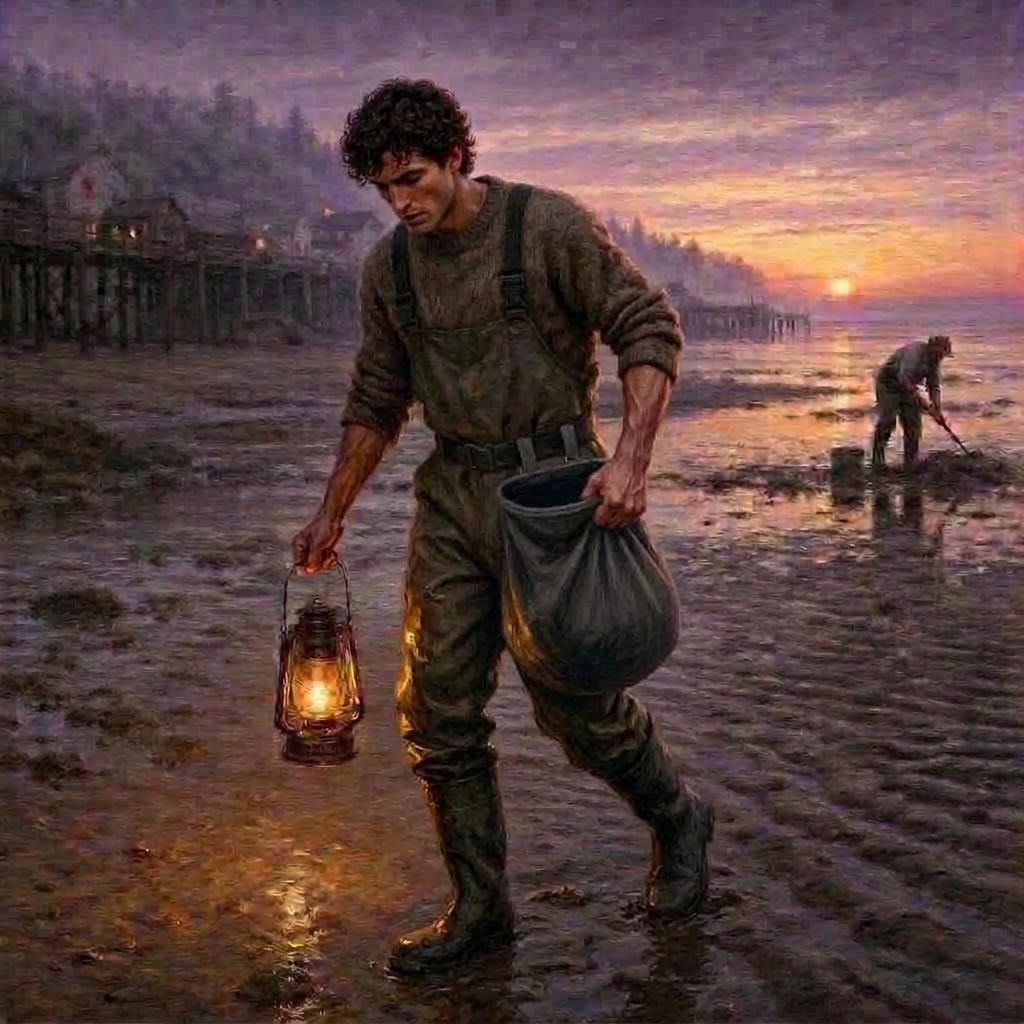
On the tidal flats of Blackwood Cove, three clam diggers discover how preparation, haste, and patient observation shape the morning’s harvest.
Part I: The Story
Chapter 1: The Tide at Low Point
In the coastal village of Blackwood Cove, life was dictated not by clocks, but by the relentless rhythm of the Atlantic tides. The cove was famous along the eastern seaboard for a rare delicacy: Blue-Ribbon Razor Clams. They lived deep beneath the wet, packed sand of the tidal flats, exposed for only ninety minutes during the lowest spring tides of the season. Restaurants in the city paid top dollar for live clams, but retrieving them was an exhausting, brutal race against time and rising water. Gareth Miller was twenty-two, lean, and possessed a quiet, meticulous nature. He lived with his grandfather, Samuel, a retired harbor master whose joints had grown stiff from decades of salt air. While most young clammers in the village spent their evenings arguing at the local tavern and sleeping until the morning sun hit their windows, Gareth spent his nights preparing. "Success on the flats isn't made on the sand, Gareth," old Samuel would say, rocking slowly on the porch as he oiled an antique lantern. "It's made in the dark before the tide turns. The ocean gives its treasures to those who arrive before the shore knows it’s naked." Gareth took his grandfather’s wisdom to heart. Every night before a spring tide, while the rest of the village was asleep, Gareth mended his mesh catch-bags, sharpened the broad steel blades of his clam guns, and studied the moonlight to calculate the exact minute the low-water mark would hit its zenith.
Chapter 2: The Fog and the Flat
The biggest tide of the year fell on an overcast Tuesday in mid-October. Low tide was predicted for precisely 5:15 AM—twenty minutes before dawn. At 3:45 AM, while Blackwood Cove was swallowed in pitch-black darkness and thick, icy sea fog, Gareth’s alarm clicked softly. He pulled on his thick wool socks, laced his chest waders, and hoisted his gear over his shoulder. His rival, Eli Hayes, lived three doors down. Eli was physically stronger than Gareth and owned a fast motorized skiff, but he relied entirely on raw muscle and luck. As Gareth walked past Eli’s dark house, he could hear the faint sound of Eli snoring through an open window. Gareth reached the edge of the mudflats by 4:30 AM. The tide was still ebbing, pulling back like a dark, heavy curtain. The sand flat was untouched, smooth as glass, and completely dark. Carrying a brass kerosene lamp in one hand and his clam gun in the other, Gareth waded out into the shallow, receding brine. The cold was sharp enough to burn his skin, but Gareth knew what he was looking for: the tiny, dimpled siphon holes left in the wet sand by the clams as they fed in the shallowest water. Because he was the first person on the flats, the sand had not been churned up by heavy boots. Every mark was crystal clear. Plunge. Twist. Lift. By 4:50 AM, forty minutes before the sun would cut through the fog, Gareth was already pulling large, fat, six-inch razor clams from the sand, dropping them with heavy plops into his mesh sack.
Chapter 3: The Rush and the Hidden Reef
At 5:20 AM, the first pale purple light broke over the horizon. A chorus of shouts and sputtering outboard engines echoed across the cove as Eli and a dozen other clammers finally arrived at the beach, rubbing sleep from their eyes and hauling their gear down the wooden ramps. "Move it, boys!" Eli yelled, running onto the wet sand with his heavy steel shovel. "Tide’s at its bottom! We’ve got an hour!" Seeing Gareth already standing fifty yards out with a half-full bag, Eli grew desperate. Wanting to cut past Gareth to reach the outer ridge, Eli sprinted blindly through the knee-deep water into an uncharted section of the flat. CRACK. Eli stepped directly into a submerged, silt-covered razor-reef sinkhole—a treacherous pocket where razor-sharp fossil shells sat hidden beneath soft mud. His boot caught, the razor edges slashed through his rubber wader, and he went down hard into the freezing brine, twisting his ankle and gasping in pain. The sudden splash and Eli's frantic thrashing sent violent shockwaves through the shallow water. The vibrations alerted the clams across the entire outer bed. Sensing immediate danger, the razor clams retracted their siphons and dug furiously down into the deep, hard-packed clay, vanishing from sight. The rest of the latecomers ran over to pull Eli out of the freezing mud, his wader flooded and his ankle sprained. In their chaotic scramble to help him, the crowd trampled the surrounding sand, ruining the visibility and burying the remaining siphon marks under churned-up silt. Eli sat on the wooden pier, shivering, soaked, and empty-handed, nursing a ruined wader and a bruised leg.
Chapter 4: The Second Wave
While the crowd rushed toward the commotion surrounding Eli, a quiet clammer named Thomas—who had waited patiently on the high shore to watch where the hazards lay—stepped onto the sand. Thomas had seen Eli trigger the dangerous sinkhole and ruin the outer sandbar. But by watching Eli's blunder and observing where Gareth had safely walked earlier, Thomas mapped out the exact safe path across the mudflats without taking a single unnecessary risk. Quietly moving along the undisturbed eastern spit—away from the mud, noise, and hidden reef—Thomas found a pristine, untouched bed of razor clams that had missed the commotion entirely. While Eli nursed his injuries and the panicked crowd argued on the pier, Thomas systematically filled his bucket with top-grade clams, completely unscathed and without a single cut on his waders. By 7:00 AM, the tide swept back over the flats, ending the harvest. The city buyers stood on the dock with their scales. Eli sat against a timber piling, broke and shivering, having sprung the hidden trap of the tide flats. Gareth sold his early catch for a strong price, but it was Thomas who walked away with the highest profit-to-effort ratio of the morning. He had risked no boots, suffered no injuries, and spent half the effort to secure his full quota. Eli looked up from the pier, watching Thomas load his clean, heavy buckets onto the buyer's truck. "How did you pull that off, Thomas?" Eli grumbled, rubbing his swollen ankle. "You didn't even start digging until half an hour after the tide turned!" Thomas smiled faintly, picking up his gear. "The early bird gets the worm, Eli," Thomas said softly, "but the second mouse gets the cheese."