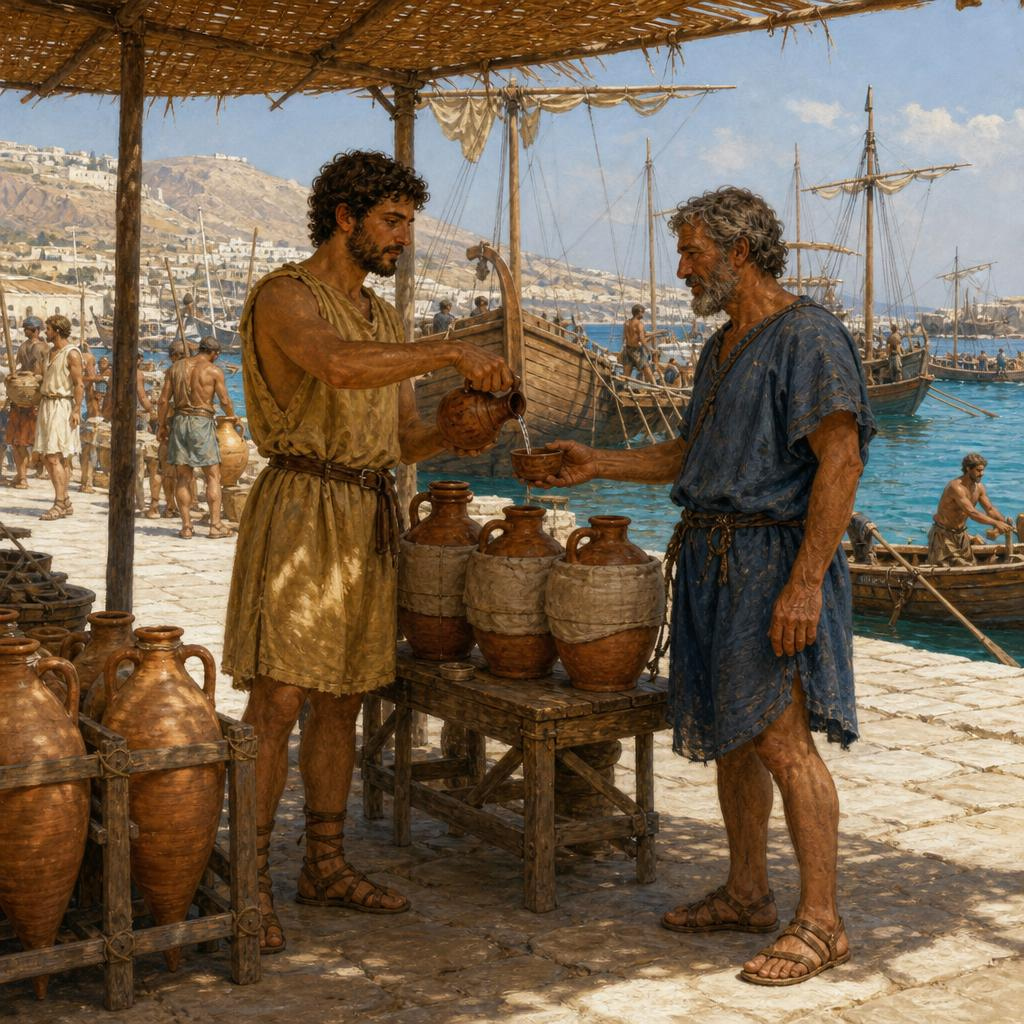
A young Boeotian merchant brings olive oil to Athens expecting a fortune, only to discover that understanding a market matters more than arriving with a full wagon.
Chapter I: The Grand Speculation
The sun was barely a sliver over the hills of Boeotia when Leontichus secured the last hemp rope around his cargo of terracotta amphorae. For three months, he had poured every drachma of his family’s inheritance into a single, audacious venture: four heavy wooden wagons laden with jars of fine green olive oil. To the small-town farmers of his valley, Leontichus was a visionary. Word had reached the countryside that the great city of Athens was rebuilding its navy, drawing sailors, artisans, and merchants to its streets. He had heard of the ships crowding Piraeus and the merchants arriving from across the sea. Surely a city feeding so many sailors and outfitting so many vessels would pay handsomely for his oil. He thought only of how much Athens might buy—not how much it already had. “You’re taking a terrible risk, boy,” warned his uncle, leaning heavily on a carved walking stick. “The roads to the south are rough, and the city is a beast that swallows young men whole.” “The city is a beast with an endless appetite,” Leontichus replied, tightening a knot with a sharp tug. “In Boeotia, oil pays for bread. In Athens, it will pay for marble. When I return, we will buy the orchard on the upper ridge.” With four hired wagon drivers and eight heavy oxen, Leontichus set off toward the Attic border. Through heat, dust, and the rocky ascents of Mount Cithaeron, he guarded his cargo like liquid gold. Every clink of the clay jars sounded to him like the promise of a fortune.
Chapter II: The Dipylon Gate
Twelve grueling days later, the dusty road gave way to the stone walls of Athens. Leontichus sat high on the driver’s seat of the lead wagon, wiping sweat from his brow as the great Dipylon Gate loomed before him. The air smelled of roasted meat, dust, and animals. Beyond the walls rose the low, constant hum of thousands of voices. Guards watched from the towers as travelers, enslaved laborers, and foreign dignitaries funneled through the double gateway. Leontichus felt a surge of pride. His oxen plodded into the Kerameikos district, their hooves striking the hard road. “Hold your beasts!” called an official, raising a long wooden staff to halt the incoming traffic. Leontichus drew back on the reins and smiled down at him. “Good day, friend. I bring four wagonloads of the finest Boeotian oil. Pure, golden oil for the kitchens and gymnasia of Athens!” The official paused, resting a hand on his hip. He looked along the line of heavily laden wagons, then back at Leontichus. His expression shifted from routine indifference to disbelief. “Oil?” he asked quietly. “The finest,” Leontichus repeated, nodding toward the sealed jars. “Ready for market.”
Chapter III: The Lesson of the Owls
The official lowered his staff and began to laugh—a loud, booming bark that caught the attention of nearby guards and fruit vendors. “What is so amusing?” Leontichus demanded, his face growing hot beneath its layer of road dust. “You brought oil to Attica?” The official shook his head, wiping a tear from his eye. He reached into a leather pouch at his belt, drew out a heavy silver tetradrachm, and held it to the afternoon light. On its reverse was the wide-eyed owl of Athens. “Young man,” said an elderly merchant named Nicarchus, who had wandered over from his shaded stall, “there is a saying in this city. When someone brings us what we already have in abundance, we say he is sending owls to Athens.” “I am no fool,” Leontichus snapped. “I am a merchant.” “Then you are a merchant who has carried sand to the beach,” Nicarchus replied gently. “Think of the country you have just crossed.” He gestured back toward the road beyond the gate, where the gray-green leaves of olive groves shimmered in the Mediterranean wind. “This is the city of Athena,” Nicarchus explained. “The olive is her sacred tree. Our groves supply us, our cellars are full, and the harbor at Piraeus is stacked with jars waiting to be shipped abroad. You have hauled your cargo to a place where merchants already have more oil than they can readily sell.”
Chapter IV: The Weight of Clay
Desperate to prove them wrong, Leontichus spent the next two days seeking buyers in the Agora, Athens’s bustling marketplace. He offered his oil to tavern keepers; they turned him away, pointing to their own full storage jars. He offered it to attendants at the gymnasia; they chuckled and quoted prices far below what he had paid. On the third day, he took the road down to Piraeus and tried the naval suppliers, but they already had standing arrangements with local merchants. By late afternoon, Leontichus sat alone on a stone step near the harbor. His money was nearly gone, spent on feed for the oxen and lodging for his wagon drivers. The heavy jars sat in a rented yard back in Athens, a mountain of unsold weight. If he could not sell the cargo, he could not pay his men to haul it home. He was ruined. As he stared down at his worn leather sandals, he noticed a group of traders from Corinth disembarking from a merchant ship. They were drenched in sweat, fanning themselves and cursing the oppressive heat. One approached a water seller, tasted what was offered, and turned away. The water had stood in the sun and was unpleasantly warm. Leontichus watched the thirsty traders searching the crowded quayside for shade. He remembered the cool water he had drunk near the Acropolis that morning. An idea began to take root.
Chapter V: Water at the Harbor
The next morning, Leontichus stopped looking for buyers willing to pay his asking price. Instead, he made a deal with a master potter in the Kerameikos. He sold his entire stock of oil at a steep discount, accepting part of the payment in cash and the rest in fifty unglazed water jars and the temporary use of two light carts with their mules. The cash covered his immediate expenses, several woven reed canopies, and a supply of drinking cups. The following morning, before the heat had settled over the city, Leontichus and his men filled the jars at a spring on the northwestern slope of the Acropolis. They wrapped the vessels in damp cloths and loaded them carefully onto the carts. As they traveled the road to Piraeus, evaporation helped keep the water cool. At the harbor, Leontichus raised a reed canopy beside the stream of arriving passengers. His men kept the jars shaded and the cloths damp. He offered a clean cup of cool drinking water and a seat out of the sun for a small coin. He had not invented water selling, nor had he discovered the harbor’s only shade. He had simply put fresh water, a sheltered seat, and an attentive welcome where tired travelers could find them. Sailors, weary envoys, and foreign merchants began to stop. Some lingered for a second cup. Others sent companions over from the ships. Within two weeks, the small business was covering its daily costs. Leontichus could pay his wagon drivers and begin rebuilding what he had lost. Recovering the rest of his inheritance would take longer, but he was no longer watching his money disappear into a yard full of unsold jars. By the time he was ready to return to Boeotia, he had settled his outstanding bills and earned a pouch of silver tetradrachms—the real “owls” of Athens. He never brought oil to Attica again. Whenever a young farmer in his village spoke of making a fortune in the big city, Leontichus would smile, draw a silver coin from his pouch, and say, “Before you drive your wagon, make sure you aren’t carrying owls to Athens.”